


Every professional lash lift and brow lamination relies on precise molecular manipulation. As a lash technician, mastering the chemical structure of natural lashes and understanding how adhesive chemistry interacts with processing solutions is essential. Rather than simply adhering to rigid timing protocols, understanding bond chemistry allows you to deliver consistent, customized, and undamaged results for every client.
The Structural Chemistry of Natural Lashes
Natural eyelashes consist primarily of complex keratin proteins structured across three distinct layers: the protective outer cuticle, the central cortex, and the inner medulla. The cortex houses helical keratin chains that determine the hair fiber’s strength, elasticity, and natural curl pattern. Within this cortex, three primary chemical bonds hold the lash architecture together:
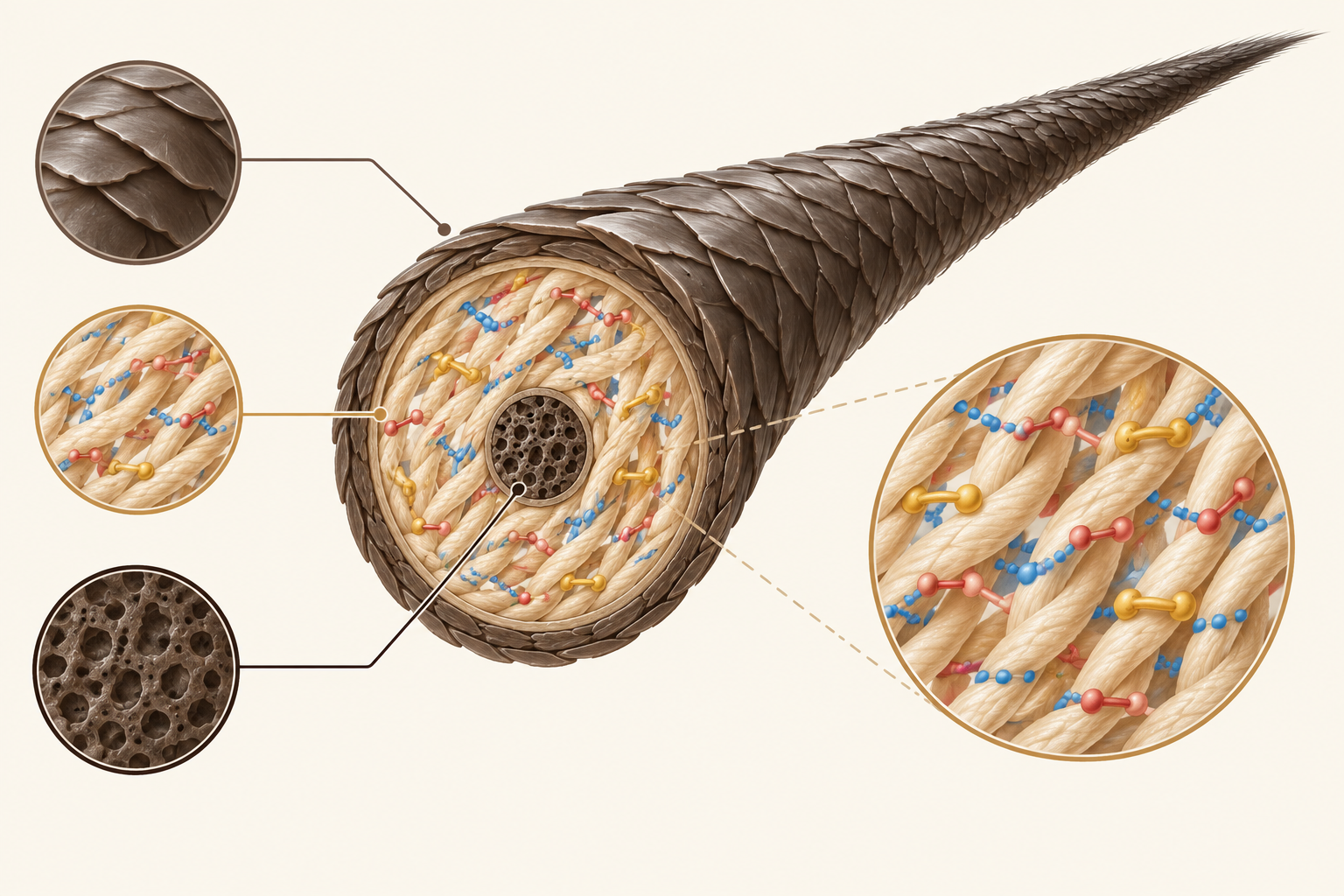
- Hydrogen bonds are weak physical connections between adjacent protein chains. They break instantly upon exposure to water or heat and reform as the hair dries, playing an important role in initial shield placement and moisture balance.
- Ionic (salt) bonds are pH-dependent electrostatic connections between charged amino acid side chains. Swelling the hair with an alkaline solution disrupts these bonds temporarily, softening the fiber matrix.
- Disulfide bonds are strong covalent sulfur-sulfur bridges between adjacent cysteine amino acids. These bridges lock the keratin chains into their natural shape and are responsible for structural rigidity.
To create a permanent change in curvature, treatments must specifically target and reconfigure these covalent sulfur bridges. For a deeper look into keratin cross-linking, review our detailed guide on lash disulfide bonds.
Chemical Processes During Lash Lifting
Lash lifting transforms hair architecture through a controlled two-stage chemical reaction: reduction followed by oxidation. Understanding each step ensures complete curl setting without compromising fiber integrity.
The Reduction Phase
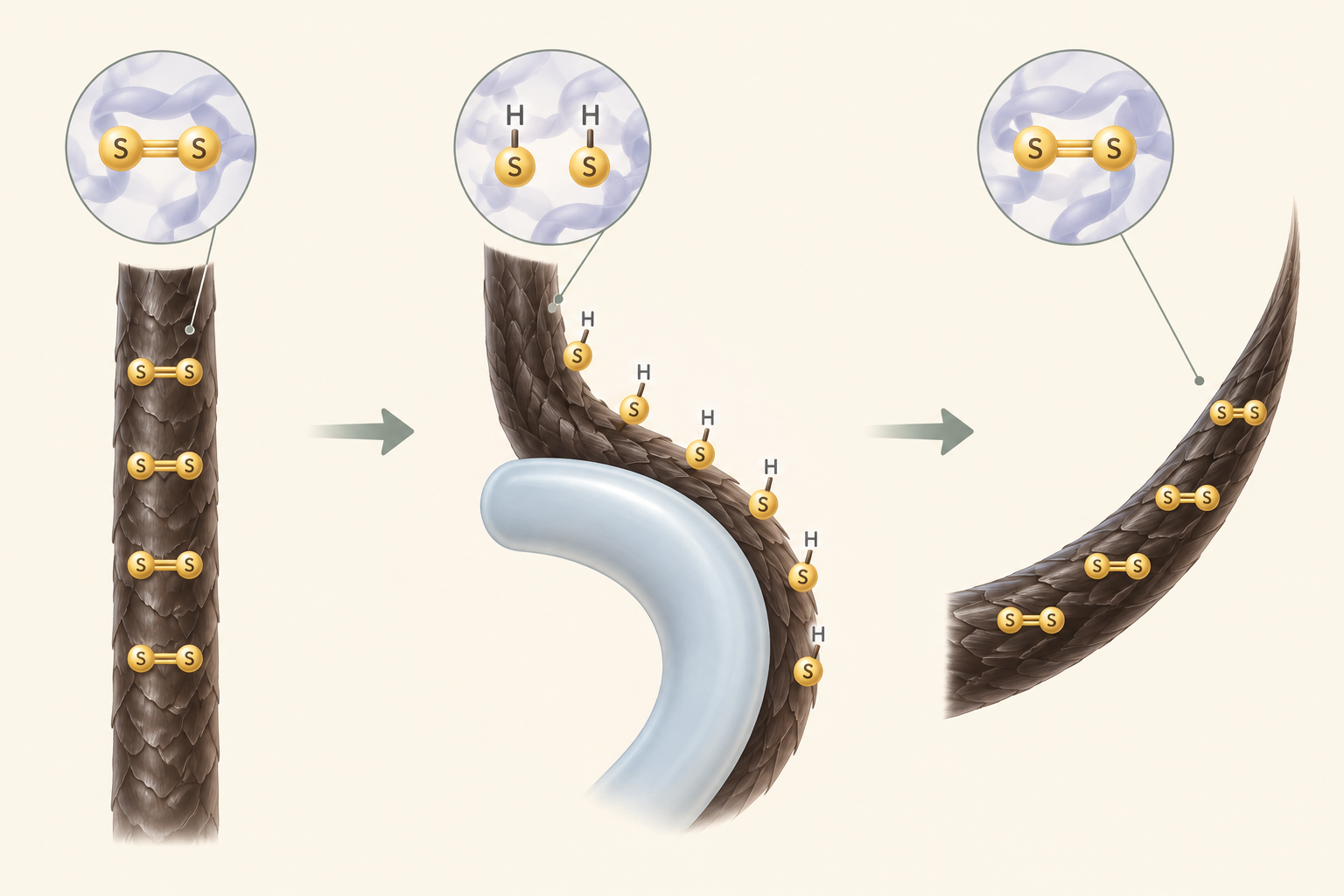
The transformation begins with an alkaline lifting lotion, typically maintained at a pH between 8.5 and 9.5. This elevated pH swells the lash shaft and opens cuticle scales, allowing active reducing agents to penetrate into the cortex. Professional formulations generally utilize Ammonium Thioglycolate or Cysteamine HCl. These reducing agents donate hydrogen atoms to the disulfide bridges, converting sulfur-sulfur linkages into weaker, temporary sulfhydryl groups. This structural softening leaves the lash completely malleable.
Technicians can choose between traditional thioglycolate systems or milder alternatives depending on client hair texture and sensitivity. You can learn more about active ingredient selection in our overview of lash chemicals and browse formulations in our classical lash lift lotions collection.

Perming Lotion (Step 1) with Aloe Vera | 10 Sachets

Perming Lotion + Fixing Lotion CLASSIC for eyelashes and eyebrows, 10 + 10 pack (20ml)
The Molding and Adhesive Phase
While disulfide bonds are split into sulfhydryl groups, lashes are secured onto silicone shields to define their new direction. Water-soluble adhesives formulated with polymers such as polyvinyl alcohol (PVA) or PVM/MA copolymers establish temporary physical hold during processing.
To achieve ideal adhesion without blocking lotion penetration, apply a thin 1mm layer of adhesive onto the silicone shield. Wait 30 to 45 seconds for the adhesive to become sticky before sweeping lashes upright with an isolating tool. Applying excessive adhesive creates a physical barrier that prevents reducing agents from penetrating the cortex evenly. For technicians evaluating different adhesive options, consult our comparison of balm glue vs traditional glue and explore our dedicated lash lift adhesives and powders.


Lash Lift Glue Powder
The Oxidation Phase
Once the reduction phase is complete and the perming solution is thoroughly removed, an acidic fixing lotion is applied. Typically formulated with hydrogen peroxide at a neutral to slightly acidic pH, the neutralizer removes hydrogen atoms from the sulfhydryl groups. This allows adjacent sulfur atoms to reunite, reforming the strong disulfide bonds in their new, curved configuration on the shield. This step locks in structural rigidity, restores fiber stiffness, and closes the cuticle.

Fixing Lotion (Step 2) with Aloe Vera | 10 Sachets
Cysteamine Chemistry and Modern Glueless Techniques
Modern lash lift formulations increasingly incorporate Cysteamine HCl, a gentle reducing agent that alters disulfide bonds with lower risk of over-processing. Cysteamine-based systems often integrate nourishing active ingredients, such as Biotinoyl Tripeptide-1, panthenol, and castor oil directly into the processing steps.
In addition, advanced technicians frequently employ glueless techniques using multi-functional glue powders. Mixing approximately 30% to 50% glue powder directly into lifting lotions increases viscosity and grip, allowing precise shield attachment without traditional sticky residue. Explore specialized options in our Korean lash lift lotions section.


Korean Lash Lift & Brow Lamination Mini Kit

Iconic Duo: 2-Step Korean Lash Lift & Brow Lamination System (Vegan, Nourishing Formula)
Technical Guidelines, Safety, and Timing
Controlling reaction rates requires precise timing and environmental management. Chemical reaction speeds accelerate under elevated ambient temperatures and high humidity. Always maintain a controlled treatment space with a room temperature between 20°C and 25°C.
Processing timing should always be tailored according to lash thickness and active ingredient concentration.
Client safety remains paramount during chemical bond manipulation. Always perform a patch test 24 to 48 hours prior to treatment to screen for localized sensitivities or allergies. Technicians must also evaluate client health history and review key contraindications for lash lift procedures before beginning.
Troubleshooting Bond Performance and Adhesive Issues
Under-Processed Lashes
If lashes fail to hold a curl, disulfide bonds were insufficiently reduced during the treatment. Common causes include under-estimating lash thickness, using expired solutions, working in cold room temperatures below 20°C, or applying too thick of an adhesive barrier. If under-processing occurs, assess lash health and consider a brief, targeted re-application using a microapplicator, checking hair texture every 2 to 3 minutes.
Over-Processed Lashes
Over-processing occurs when chemical exposure breaks down excessive disulfide bonds, leading to frizzy or damaged lash tips. To prevent over-reduction, never apply perming or fixing lotions directly to the delicate lash tips. If over-processing occurs, immediately remove all chemical residue and apply a nourishing lamination cream or keratin serum to restore moisture. Avoid adding additional chemical processing until the natural lash growth cycle resets.
Adhesive Residue Management
Thick adhesive build-up near the eye line can irritate client eyelids and interfere with clean finish photos. To remove stubborn glue safely after fixing, saturate a lint-free microfiber swab with an oil-free cleanser or lamination cream to gently dissolve the water-soluble adhesive matrix. Work from the outer corner inward without pulling on natural lashes. For step-by-step cleanup protocols, read our guide on how to get glue off eyelids after lash lift.
Refining Your Chemical Mastery
Understanding the interplay between hair structure, active reducing agents, and adhesive formulations shifts your practice from simple application to true chemical mastery. By customizing processing times, monitoring environmental conditions, and applying precise adhesive layer thickness, you ensure healthy, resilient lashes with lasting curl performance.
To expand your salon’s chemical toolkit and explore professional perming systems, browse our full range of lash lift lotions and elevate your service quality today.
