

A natural eyelash grows about 0.12 mm per day while it is in its active phase, and a lash that has finished growing stays between 8 and 12 mm long. That is the whole growth story in two numbers. For a technician the more useful question is how many lashes are actually growing on the day you treat, because that decides how quickly a lift fades and when a client should rebook.
The short answer is that only a minority of lashes are growing at any moment, the cycle varies a lot between clients, and the data behind the commonly quoted figures comes from small studies. Treat the numbers below as planning ranges, not as promises to clients.
| Phase | What happens | Reported duration |
|---|---|---|
| Anagen (growth) | Follicle is attached to its blood supply, lash lengthens at roughly 0.12 mm/day | 34 ± 9 days measured in one study; 4–10 weeks in reviews |
| Catagen (transition) | Growth stops, follicle regresses | About 15 days |
| Telogen (rest) | Lash stays in place until it sheds | Over 100 days in one report; up to 9 months in reviews |
| Full cycle | Growth through to replacement | About 90 days measured; 4–11 months in reviews |
What the research actually measured
The most cited measurement comes from Thibaut and colleagues, published in the British Journal of Dermatology in 2010. They collected lashes from 29 women aged 26 to 60 and followed four of them weekly for nine months. Average growth was 0.12 ± 0.05 mm per day, the anagen phase averaged 34 ± 9 days and the complete cycle 90 ± 5 days. The authors also noted that growth rate varied considerably between people.
Review articles on eyelash serums give wider figures: anagen of roughly 4 to 10 weeks, catagen of about 15 days, telogen of several months, and a full cycle of 4 to 11 months. The two sets of numbers do not reconcile neatly. At 0.12 mm/day, 34 days of growth gives about 4 mm, while a mature lash reaches 8 to 12 mm, which needs roughly 10 weeks of uninterrupted growth. The practical reading is that cycle length differs between clients, between the upper and lower lid, and from lash to lash.
One more figure worth knowing: a lash that has been pulled out takes about eight weeks to grow back, according to a clinical reference on cilia disorders. That is a useful answer when a client asks how long a gap from tweezing or rubbing will take to fill in.
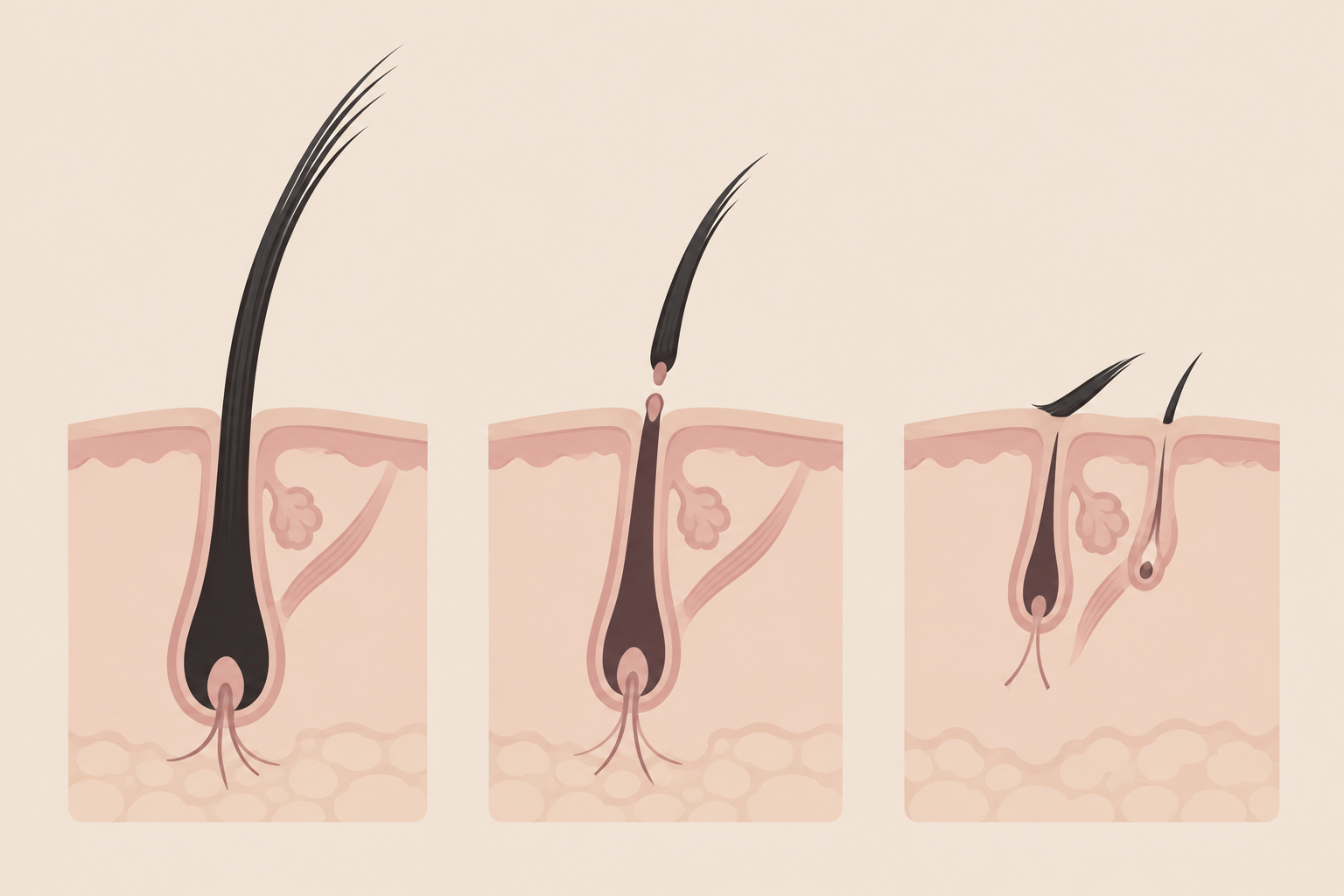
Why the lash line never grows in sync
Each follicle runs its own clock, so lashes of every age and length sit side by side on one lid. This is what prevents sudden bald patches, and it is also why a lash lift never ends on a single day.
A small histology study of eyelid specimens found actively growing follicles in about 41% of upper-lid follicles and 15% of lower-lid follicles. Another source puts the share of follicles in telogen at roughly 50% for eyelashes, against 5–15% for scalp hair. Both point the same way: on a typical client, most upper lashes are not lengthening at the moment you work on them, and the lower lid is even more dominated by resting lashes.
Lash counts also differ more than most technicians expect. One clinical study averaged 72 upper and 38 lower lashes per lid, while a review quotes 90–160 on the upper lid. Your own mapping of the client’s lash line is a better baseline than any average.
Our own shedding guidance puts normal loss at roughly 1 to 5 natural lashes per day per eye. Use that as a reference when a client panics about lashes on the pillow after a service. A shed lash that carries a lifted curl is not proof of damage. It is the cycle doing what it does. The eyelash shedding article covers the seasonal pattern in more detail.
How growth rate shapes lash lift longevity
A lash lift reshapes the lash you can see by breaking and re-forming disulfide bonds in the keratin. Cleveland Clinic states it plainly: the curl can make lashes look longer, but the treatment does not make them longer or thicker,. The lift therefore lasts only as long as the treated hairs stay in place. Vogue’s lash lift guide quotes the same 6 to 8 week range and adds that a slower lash cycle, which comes with age, means a longer-lasting lift.
Two groups of lashes behave differently after a service:
- Lashes in telogen or late catagen are fully grown and hold the curl until they shed, then a short untreated lash replaces them.
- Lashes in anagen keep lengthening, so untreated hair emerges from the base and the lifted section moves away from the lid.
You can put numbers on the second group. At 0.12 mm/day a growing lash adds about 0.8 mm per week, so after four weeks roughly 3.4 mm of the lash is untreated and after six weeks about 5 mm. On a 10 mm lash that is half the length, which is why the curl looks as if it has dropped to the tips even though the lift has not “worn off”. This is arithmetic from the average growth figure, so expect a client with slow growth to look better for longer and a client with fast growth to look flatter sooner.
Setting the rebooking interval
Our standard is 6 to 8 weeks between lash lifts. Four weeks is the absolute minimum and belongs to rare corrective cases such as severe under-processing, not routine maintenance. Waiting 6 to 8 weeks gives the lash bed time to shed previously lifted hairs, so most of what you process is fresh. The full reasoning sits in our guide on how soon you can redo a lash lift.
Extend the gap to 10 to 12 weeks, or longer, when the lashes show dryness, brittleness or breakage. Reprocessing already stressed shafts is how thinning begins.
Do not try to schedule a service for “early anagen”. Because lashes cycle asynchronously, you cannot choose a phase, and a plan built on it will fail the first time a client’s cycle runs differently from the textbook. What you can control is the chemistry. Keep the lotion to a 1 mm layer on the base and mid-zone, hold it 1 to 2 mm away from the root, and keep it off the tips. For thin or soft lashes our timing guide suggests 4 minutes for the lifting lotion and 4 minutes for the fixing lotion, and for thin or brittle lashes reducing exposure by 15% to 20% helps avoid over-processing. See lash lift timing and eyelash follicle anatomy for the full protocol and the structure behind it.
Between appointments, daily conditioning keeps the shaft supple while it grows out. Our Nutrilash serum is a mascara-style conditioner with hydrolyzed keratin, sodium hyaluronate and hydrolyzed silk, and it contains no prostaglandin analogue. It works on the lash shaft, so describe it to clients as aftercare rather than as a way to speed up growth.


When slow growth or loss needs a different answer
A client who says her lashes never grow past a certain point may simply be at her genetic cap. Lashes reach a set length and then fall out by themselves, and length can differ widely between people. One uveitis study also found that lash length was negatively correlated with age in both patients and controls. Slow, even turnover with normal density is a reason to extend the interval, not a reason for concern.
Patchy loss, bare segments or a sudden drop in density are different. A few conditions are worth knowing so you can recognise when a client should see a doctor instead of booking a service:
- Alopecia areata can affect the lashes, more often the upper lid. In a case series of 15 patients, 40% had complete regrowth during follow-up.
- Trichotillomania, the compulsive urge to pull hair, can produce broken lashes along the lid and in some cases complete loss.
- Blepharitis, inflammation at the lid margin and lash base, can progress to lash loss or irregular lashes. Demodex mites are associated with anterior blepharitis, although they also live on people without symptoms.
- Chemotherapy and other cancer treatments can remove lashes, and recovery depends on the treatment and dose.
- Thyroid disease, in a published case, caused lash loss that regrew after treatment.
Lash extensions deserve a note in your consultation form. In a study of young women, wearers reported natural lash loss more often than non-wearers (17.3% against 9.6%). That shows an association, not proof of cause, but a client with heavy extension history and thin natural lashes should have a longer recovery gap before a lift. Our contraindications guide lists the eye conditions and sensitivities that rule out chemical services.
Can growth rate be changed?
The best-documented approach is a prescription drug. In the trial reviewed by the FDA for Latisse (bimatoprost 0.03%), 278 adults were treated for 16 weeks. Users had lashes that were on average 25% longer, 106% fuller and 18% darker than baseline, against 2%, 12% and -3% for the vehicle group. The drug works by prolonging anagen. When treatment stops, lashes are expected to return to their pre-treatment appearance over several weeks to months.
That has two consequences for you. First, a client using a prostaglandin product will have longer lashes than her natural cycle gives, and the effect will fade after she stops, so ask about it at consultation. Second, prescription treatment is a medical decision. Refer clients who want it to their doctor, and do not recommend or supply it yourself.
Cosmetic serums, diet and other advice do not have comparable data behind them. Be careful about promising growth, and describe conditioning for what it does: reduce breakage and keep the lash in good condition while it completes its natural cycle.
Turning growth data into a rebooking rule
Record the date, lash length and density on every client card, and photograph the lash line at each appointment. At the next visit compare the two. A client whose curl is still holding at week 6 can wait for week 8; one whose lashes look dry should wait for week 10 to 12. Even with no formal measurement, that comparison is more reliable than any average growth rate.
The takeaway is simple: lashes are asynchronous, so you plan around the client in front of you instead of around a phase. If you want a consistent, gentle system to build those intervals around, browse our Korean lash lift lotions and lash lift kits, then set your rebooking rule at the next consultation.
