

Thioglycolate (TGA) and cysteamine HCl do the same job: they break the disulfide bonds in the lash or brow keratin so the hair can be reshaped. TGA is the faster, stronger reducer and the more reliable option on coarse, resistant hair. Cysteamine is the usual choice for fine, fragile or previously lifted hair, but it is not automatically “gentler”, and it brings its own safety points. The right choice depends on the hair, not on a reputation.
| TGA (ammonium / ethanolamine thioglycolate) | Cysteamine HCl | |
|---|---|---|
| Reduction speed | Depends on the % of active ingredient | Depends on the % of active ingredient |
| Best on | Coarse, resistant, downward-growing lashes | Fine, fragile or previously lifted lashes and brows |
| Odour | Stronger at the time of treatment | Milder, but a delayed smell can appear days later |
| Skin allergy | Ammonium thioglycolate is a rare allergen | Documented occupational contact allergen |
| Regulation (EU) | Capped at 11% for eyelash waving, pH 7–9.5, professional use only | Check the supplier’s safety assessment |
How both actives work
Both are reducing agents. At an alkaline pH, they release reactive thiolate ions that attack the cystine bridges (disulfide bonds) in the cortex. The fixing lotion, which contains an oxidiser such as hydrogen peroxide, then rebuilds the bonds in the new shape. A lash lift is only as good as that second step, so the fixing time should always match the lifting time.
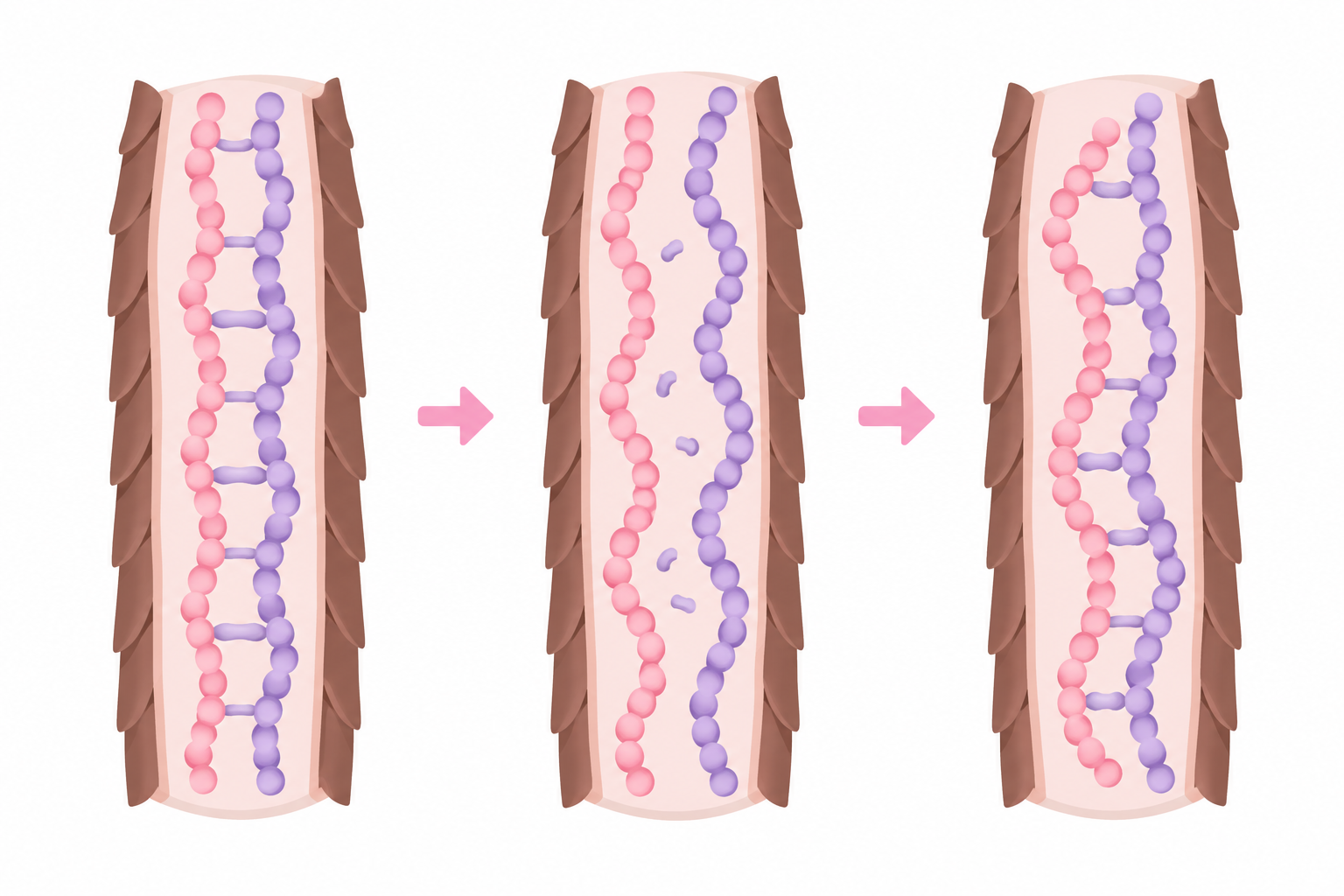
The difference is how hard each active works at a given pH. In a classic laboratory comparison on virgin human hair published in the Journal of Cosmetic Science, 1 M ammonium thioglycolate at pH 9.4 reduced the stress-bearing disulfide bonds faster than 1 M cysteamine at pH 7.6, even though both solutions contained the same concentration of active thiolate. That is scalp hair at 23 °C, not lashes, so treat it as direction rather than a processing chart. It does explain what technicians see in the chair: cysteamine needs more time, or more active thiolate, to reach the same bond reduction.
TGA: speed, power and a narrow window
Ammonium thioglycolate has been the standard perming agent for decades. Our Classic lotions use a blend of ethanolamine thioglycolate and ammonium thioglycolate in Step 1, with hydrogen peroxide in the fixing lotion. The advantage is predictability on stubborn hair: lashes that are thick, “glassy” or growing straight down tend to respond where weaker systems stall.
The cost is a narrow margin. Strong reduction means the gap between under-processed and over-processed is small, so TGA suits technicians who time the service and check a test lash rather than going by the clock. If you regularly see lifts that drop or lashes that go frizzy, our guides on lash lift underprocessing and lash lifting timing walk through the diagnosis.
TGA is also the one active with a dedicated EU limit for eyelashes. Annex III of Regulation (EC) 1223/2009 allows thioglycolic acid and its salts in eyelash-waving products up to 11%, at a ready-to-use pH of 7 to 9.5, for professional use only. The EU’s scientific committee (SCCS) advised in 2013 against consumer self-application because of the risk of eye irritation. That is a good line for your consent form and a reason not to sell perming lotions to clients for home use.

Cysteamine HCl: lower pH, softer feel, longer processing
Cysteamine HCl is a small amine-based thiol. Because it works well at a lower pH than TGA, it is the active behind many Korean-style, glueless and nourishing systems. A study on head hair that compared a cysteamine-HCl lotion (pH 9.31) with a sodium thioglycolate cream (pH 9.97) found more negative effects on the hair from the thioglycolate lotion and from repeated waving. The two lotions differed in pH and format, so this is not proof that the active alone causes the difference. A review in the Journal of Cosmetic Science makes the same point: calling cysteamine “less damaging” can be technically correct, but the two systems rarely achieve the same degree of reshaping, so the comparison is not like for like.
In practice, do not assume cysteamine is always lower in pH. If pH matters to your protocol, ask the manufacturer for the figure instead of assuming it from the active.
Processing time is where cysteamine differs most visibly. For Iconic Duo, we recommend 4 minutes for thin hair, 6–7 minutes for medium and 8–10 minutes for strong lashes or brows, with the same time on the fixing lotion. A strong-lash client therefore spends 16–20 minutes in chemistry across both steps. Those are indicative times, and you should check a test lash before you move on. The formula is conditioning enough that no separate Step 3 is needed.


Safety, skin and smell
Neither active is risk-free, and the old advice that one is “the safe one” does not hold up in the literature. Cysteamine HCl is a recognised occupational allergen: a study that patch-tested 1,347 hairdressers between 1994 and 2004 found 16 positive reactions (1.2%), all clinically relevant to their dermatitis. Ammonium thioglycolate, by contrast, is described in a review of hairdresser allergy as a rare allergen, while glyceryl thioglycolate is the more sensitising thioglycolate. These are different studies in different populations, so they do not give a head-to-head rate. What they do mean for you is that wearing gloves and keeping lotion off your own skin matters with either active.
For clients, a 24–48-hour patch test before the first service applies to both systems. Our guide to the brow lamination patch test covers the protocol, and the lash lift consultation guide covers health screening. Any reducing lotion can burn skin if it sits too long or touches compromised skin, especially on brows, so keep it off the skin and remove it at the set time.
Smell is a client-experience issue. Thioglycolates have the more noxious odour at the time of treatment. Cysteamine perms were introduced as low-odour, but the same review notes a delayed odour, sometimes compared to wet dog, that can appear days to a week after use. Tell clients about it up front so they do not read it as a sign of damage.
Choosing for each client
Start with the hair, then the method you want to offer.
- Coarse, downward-pointing or resistant lashes: choose TGA. It reduces strongly, so you can reach a defined lift without extending the timer. Check lash porosity first, because it affects how fast the lashes process.
- Fine, fragile or previously lifted lashes: choose cysteamine HCl and start at the low end of the time range. The slower reduction gives you more room to stop at the right point.
- Strong lashes that you want to lift gently: cysteamine still works, but plan for 8–10 minutes per step rather than shortening the time and getting a weak curl.
- Brows: choose by hair type, not by the active’s reputation, and keep the patch test routine because the lotion sits against the skin for the whole processing time.
- Glueless or Korean-style lifts: these are built around cysteamine formulas. Our comparison of classical, Korean and hybrid lash lifts explains how the method changes the choice.
Do not switch actives and times on the same client in a single visit, and do not mix products from different systems in one service. If you stock both, record which one you used and the timing on the client card, so the next visit can be adjusted rather than guessed.
Whichever lotion you choose, finishing with a lamination cream seals the cuticle and adds nourishment when the lotions themselves are not conditioning.

Choosing between TGA and cysteamine is a matching exercise: stronger chemistry for resistant hair, a slower and softer system for fragile hair, and the same discipline on timing, gloves and patch tests either way. If you want both options on your shelf, browse our lash lift lotions and Korean lash lift range, order a sample set, and run each on a test client before you commit to a full box.
