

Brow tinting is a semi-permanent colour service: an oxidative tint is mixed with a developer, brushed over the brow hairs and a thin band of skin, left to develop for a few minutes and wiped off. The colour sits in the hair shaft for roughly 3 to 6 weeks, while the stain on the skin fades in a few days. Most technicians rebook clients every 4 to 6 weeks. Always patch test at least 48 hours ahead, and when tinting is part of a lamination, apply it after neutralising, with a shorter development time.
| Question | Short answer |
|---|---|
| How long does tint last on the hair? | About 3 to 6 weeks; Biosmetics states 4 to 7 weeks for its tints |
| How long does the skin stain last? | A few days, up to about a week |
| How often can you re-tint? | Every 4 to 6 weeks is the usual rhythm; leave at least 3 weeks between tints |
| Development time for brows | 2 to 10 minutes, depending on hair and desired depth |
| Tint with lamination? | After neutralising and before the nourishing step, with reduced timing |
What brow tinting does and what it can’t
Tint darkens existing hairs, including the fine, pale ones that are invisible bare, and lightly stains the skin beneath. That is why a tinted brow looks fuller without a single hair being added. It does not change hair direction, so brows that grow down or cross over will go straight back to their habits. If a client’s real complaint is shape, you are looking at brow lamination, with tint as the finishing layer.
Henna is a different category. Henna stains the skin more heavily than a standard tint, with skin colour lasting up to roughly two weeks, where a standard tint’s skin stain disappears in days. Clients who ask for “henna brows” often want that tattoo-like skin effect, so ask what they expect before choosing a product.
How long tinted eyebrows last
Practitioner sources consistently split the answer into two parts. The stain on the skin lasts a few days to about a week. The colour in the hair lasts as long as the tinted hair does, which is typically 3 to 6 weeks. Biosmetics, the German range we stock, describes 4 to 7 weeks on its product pages.
The tint does not wash out so much as grow out: tinted hairs shed and new, untinted ones replace them. Several things shorten the visible result. Oily skin usually fades colour sooner than normal or dry skin, and oil-based cleansers and makeup removers break down fresh tint. Heat, chlorine and sun (saunas, hot yoga, pool swimming) speed up fading, and exfoliating actives near the brow lift the skin stain so the brow looks lighter faster.
Set the expectation at the consultation. A client who hears “three weeks of strong colour, then it softens until week five or six” is far less likely to feel short-changed than one promised six weeks.
How often can you tint eyebrows?
Four to six weeks suits most clients, and many studios rebook at four. Some manufacturers and studios set three weeks as the minimum gap between tints to avoid over-processing, and that is a sensible floor. Hair that is repeatedly tinted at short intervals can dry out, so offer a nourishing serum or brow oil at home between visits.
Patch testing follows its own schedule. Repeat it for a new client, a new brand or shade range, a change in the client’s health or medication, and after a long gap since the last tint. Treatwell’s guidance, for instance, is to retest if six months have passed without a treatment. A client who has tinted for years can still develop a sensitisation, and the reaction happens very close to the eye. For the lamination side of the scheduling question, see our guide to how often you can laminate brows.
Patch testing and safety
Most oxidative tints contain para-phenylenediamine (PPD) or related dye intermediates, which are the usual cause of contact dermatitis. Test with the mixed tint, exactly as you would use it in the service, on the inner elbow or behind the ear. Manufacturers’ protocols range from 24 to 72 hours of observation, so follow the one printed for your product; 48 hours before the appointment is the common industry standard. Record the date and test site. Redness, itching or swelling means no treatment. Our brow lamination patch test protocol covers the documentation side, and the lash tint safety guide applies the same principles near the eye.
Check what your jurisdiction allows before you buy a tint. In the US, the FDA states that no color additives are approved for permanent dyeing or tinting of eyebrows or eyelashes, apart from silver nitrate in professional-use cosmetics at up to 4% in a viscous gel, and its guidance on coal-tar hair dyes warns against using them on brows. In the EU, products containing 2-Chloro-p-Phenylenediamine may not be placed on the market for colouring eyebrows or eyelashes (the ban applied from November 2019, and from February 2020 for products already on sale). Use only products made and labelled for brows and lashes, never scalp hair dye, and confirm local licensing and insurance rules.
Tinting step by step
Brow tinting is quick, but the details decide whether the result is crisp or muddy.
- Cleanse and dry. Remove makeup with an oil-free cleanser. Oil and sebum act as a barrier, so tint will not take evenly on an oily brow.
- Map the shape. Decide the borders before any tint touches the skin.
- Protect the skin. Brand protocols use petroleum jelly around the brow, which is also used to limit skin staining with dark shades.
- Mix just before use. Brands differ. One common instruction is a 1:1 ratio of tint to developer, around four drops of developer to a creamy paste. Follow the sheet for your system and never reuse a mix.
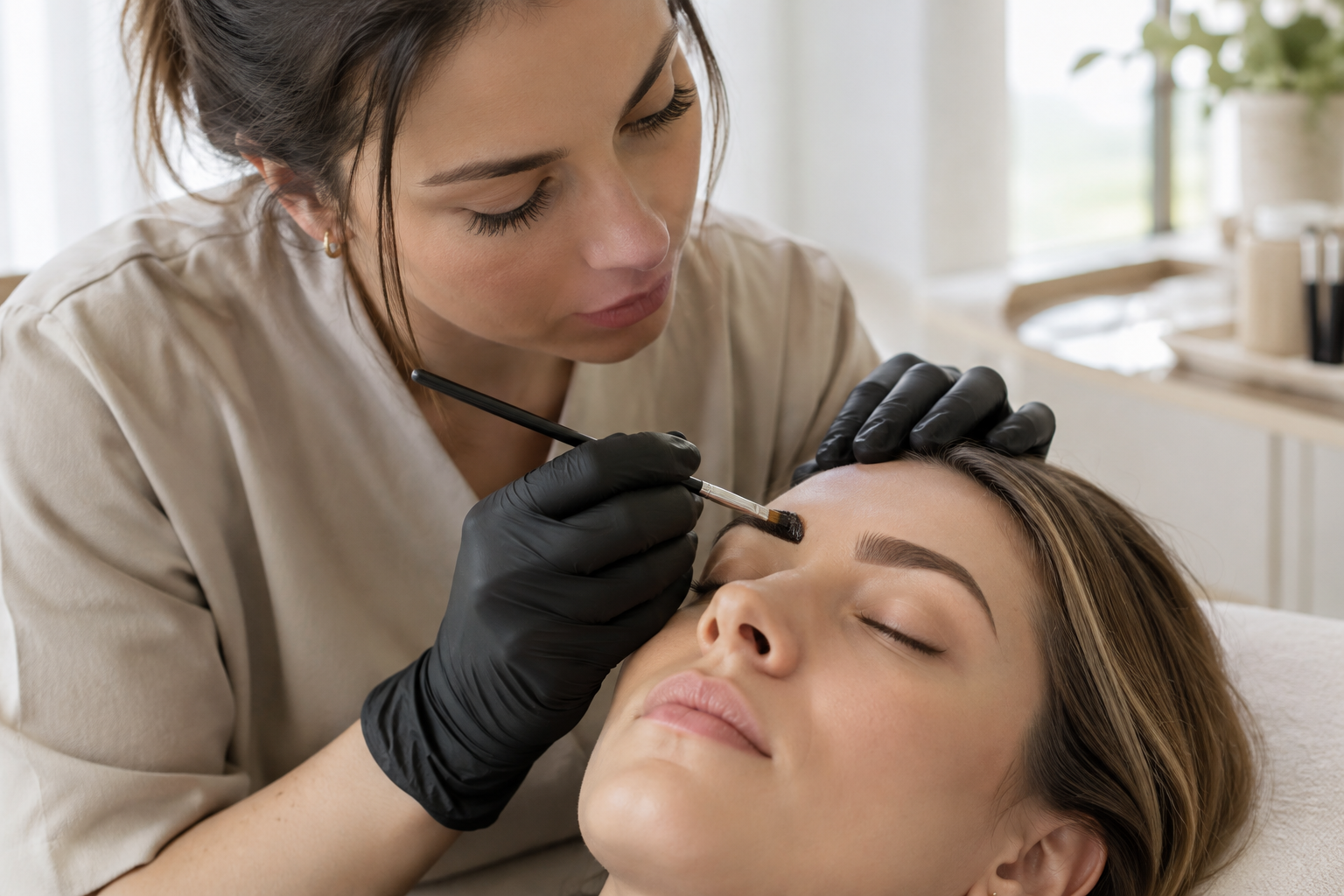
- Apply and time it. Work from the tail towards the front, one brow at a time. Biosmetics lists 2 to 10 minutes for brows.
- Test a strand. Wipe a small section at the inner corner with damp cotton. If it is too light, reapply and keep going.
- Remove thoroughly. Wipe with damp cotton pads until the pad comes away clean, then move on to any shaping.
The Biosmetics line we stock comes in 20 ml tubes in several shades, and it pairs with a 2% cream oxidant. A glass dappen dish keeps the mix smooth and a disposable brush avoids cross-contamination between clients.


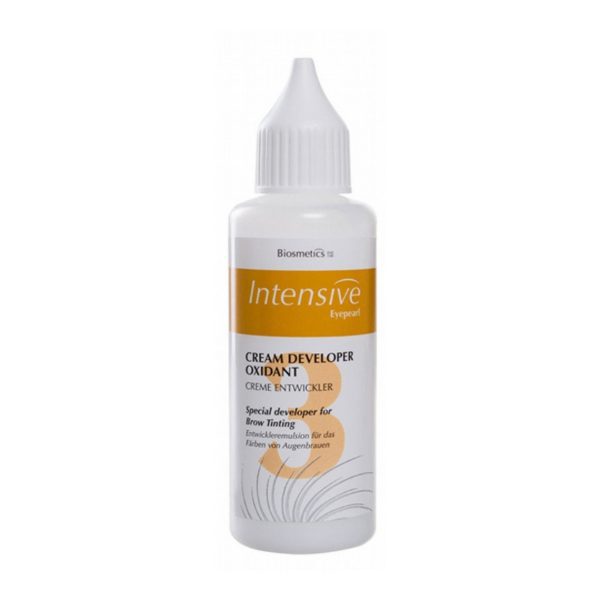


For timing, anchor on hair type. Our own technique notes suggest a baseline of around 7 minutes for fine blonde hair against around 12 minutes for coarse dark hair using the same tint, and then adjusting from the strand test. Keep those baselines in each client’s record so the second visit is faster and more consistent than the first.
Choosing a shade
Look at the lightest and darkest hairs in the brow rather than judging from a distance, then factor in skin undertone and the finish the client wants. Our guidance is to choose a shade that matches or sits one to two shades darker than the client’s darkest natural hair, going softer on mature clients. Warm undertones usually suit golden browns; cool undertones suit ash tones.
Blonde and light-brown clients are the common trap. Pitch black on a blonde looks harsh, so go for a soft brown or taupe, and blend two tints (for example brown and black) for a custom in-between shade instead of settling for the nearest tube. Skin staining is also stronger with dark brown and black, which is one more reason to use a barrier.
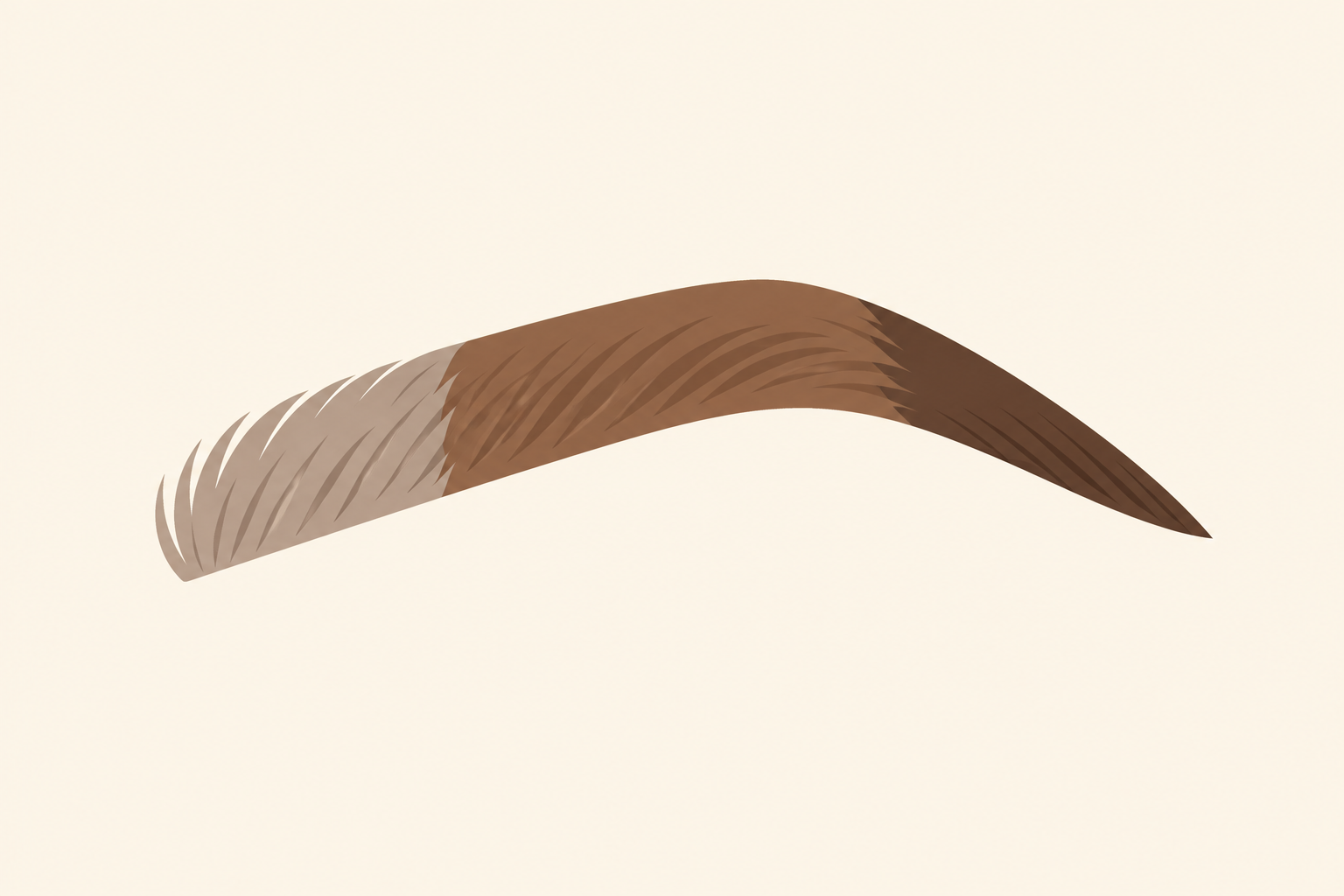
For a modern, less blocky result, avoid one flat colour. Apply lighter pigment at the front and build saturation through the arch and tail, as in the illustration below.
Tinting with brow lamination
Tint after lamination, not before. The alkaline perming lotion can strip or dilute fresh pigment and leave it patchy. The usual place in the sequence is straight after the neutralising or fixing lotion is removed and before the nourishing step; some systems let you mix tint directly into the fixing stage, so read the manufacturer’s instructions. Remove every trace of lotion first.
The reason to shorten timing is porosity. Lamination opens the cuticle, so the hair takes up colour much faster than on an untreated brow. With Biosmetics, start checking at about 2 minutes instead of running the full 10, and remember that colour can be built up again but not taken out. Our article on tinting before or after brow lamination goes through the sequence in detail, and a complete brow lamination kit gives you the lotions to build the full service around the tint.


Fixing common tint problems
Too dark. Processing time is the main driver, followed by a shade chosen too deep. A fresh tint also looks stronger on day one, partly because the skin stain is at its peak. Wait for the skin to settle before judging; if the hair itself is too deep, a tint remover can help.
Patchy or uneven. Fine, porous hairs grab colour quickly, while coarse or resistant hairs need more time, and bleached or sun-damaged hairs absorb unevenly. Recent waxing and oily skin also change how evenly colour is accepted. Strand-test and tint different areas in sequence.
Fades fast. Check the aftercare first. Keep the brows dry for 24 to 48 hours, avoid oil-based removers and heavy creams on the brow, and skip saunas, swimming and hard sweaty workouts during that window.
Skin reaction. Rinse off any remaining tint without scrubbing, stop the service and keep the area free of makeup. Swelling of the lips, mouth, tongue or throat, or trouble breathing, needs emergency care. For burns and other adverse reactions, read how to treat a chemical burn from brow lamination and when to refer the client to a doctor.
Brow tinting rewards technicians who treat it as a precise chemical service rather than a quick add-on: patch test every time, time the tint by hair type, strand test, and set honest expectations of 3 to 6 weeks. If you want to put that into practice, browse our eyebrow tint range and build a tint shelf your clients can rebook around.
